Help
Data Sync
Airgentic Help
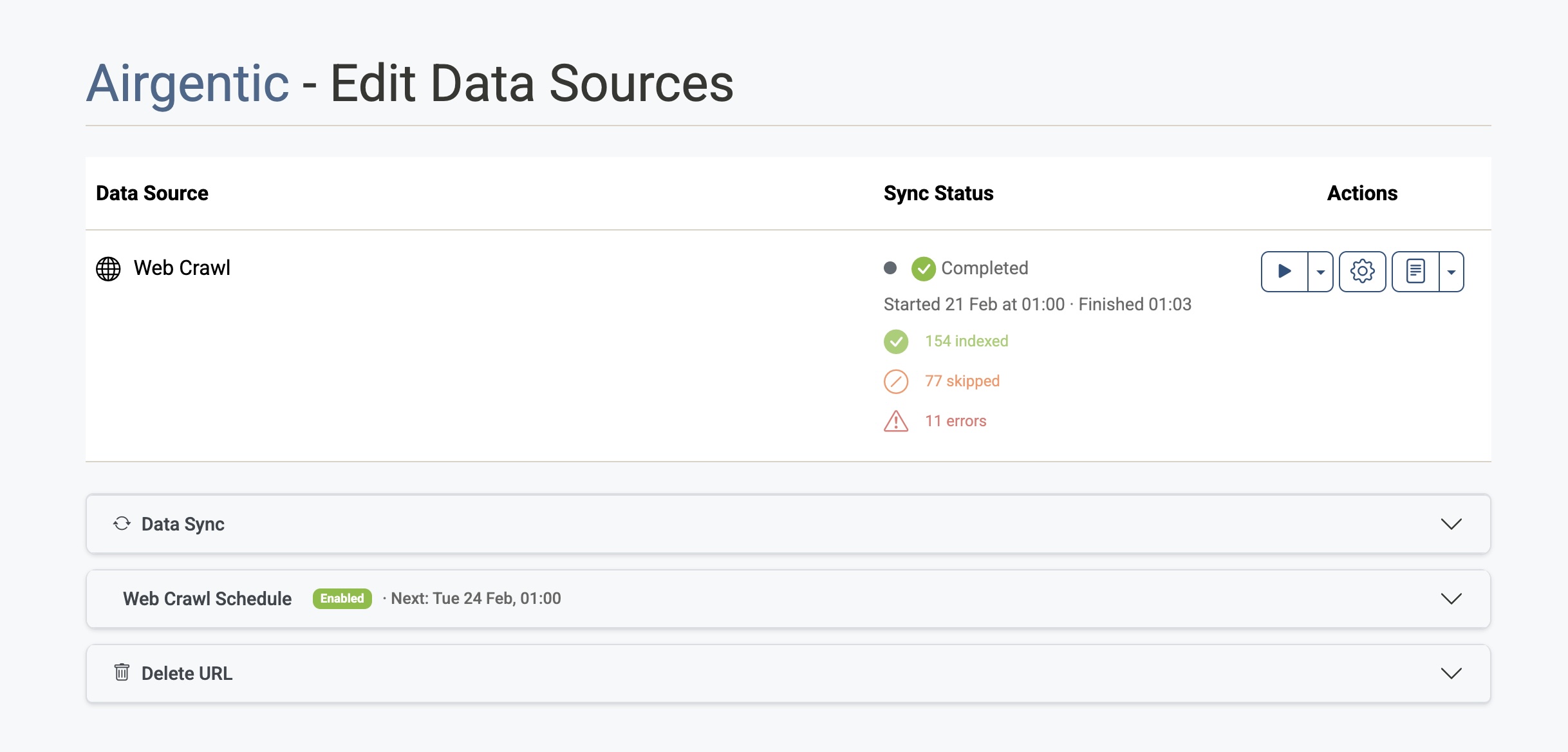
The Data Sources screen shows your data sources (such as Web Crawl), their sync status, and lets you run a sync manually or on a schedule. This guide describes the Data Sync section and how it fits with crawler settings.
What is data sync?
Data sync pulls content from your configured data sources and updates the index used by the AI. For a web crawl data source, that means fetching pages, processing them, and indexing the results so the AI can answer questions from your site.
Where to find it
- Log in to the Airgentic admin console.
- Click the black 'Data Sync' button for the selected service.
You'll see a table of data sources (Web Crawl and JSON Feed), each with Sync Status and Actions, and below that the Web Crawl Schedule and Delete URL sections.
Upload Documents
If you need to index content that isn't available via web crawl—such as internal PDFs, Word documents, or standalone HTML files—use the Upload Documents button at the top of the page. This opens a dedicated screen where you can drag and drop files, manage uploaded documents, and trigger indexing.
See the Upload Documents guide for full details on supported file types, public vs. secure storage, and how indexing works.
Sync status and actions
Each data source row reports on its own runs only. In the table at the top of the page:
- Sync Status — Shows when that data source last ran and whether it completed or failed. The Web Crawl row shows how many pages were indexed, queued, skipped, or had errors. The JSON Feed row shows how many records its feeds returned, how many were new or updated, unchanged or removed, and any feeds that could not be fetched. A data source you haven't set up shows Not configured.
- Play — Start a sync for that data source on demand. On the Web Crawl row, the dropdown starts a single processing stage (e.g. Process HTML, Index Content). These stages reprocess everything the service has downloaded, so their results appear on the Web Crawl row.
- Gear — Open that data source's settings. For Web Crawl this is Crawler settings (seed URLs, crawl scope, image extraction, standard result fields); for JSON Feed it is the list of feeds.
- Logs — View that data source's log. On the Web Crawl row, the dropdown opens the processing stage logs (HTML processing, indexing, etc.).
Only one job runs for a service at a time. While one is running, a bar above the table shows what it is and lets you cancel it.
Web Crawl Schedule
Below the data sources table, Web Crawl Schedule lets you enable or disable automatic syncs and set the time and days of the week. Times use your local timezone. The next run time is shown in the accordion header when the schedule is enabled.
Crawler settings
To control what is crawled (URLs, scope, images, standard result fields), use the gear icon in the Actions column for the Web Crawl row. That opens the Crawler settings screen (General, Crawl Scope, Image Extraction, Standard Result Fields). Configure crawler settings first if you're adding a new site or changing which pages are included.